
CONSTRUCTION DEPOT JOURNAL
Florida Lot Driveway Access: What to Confirm Before Design
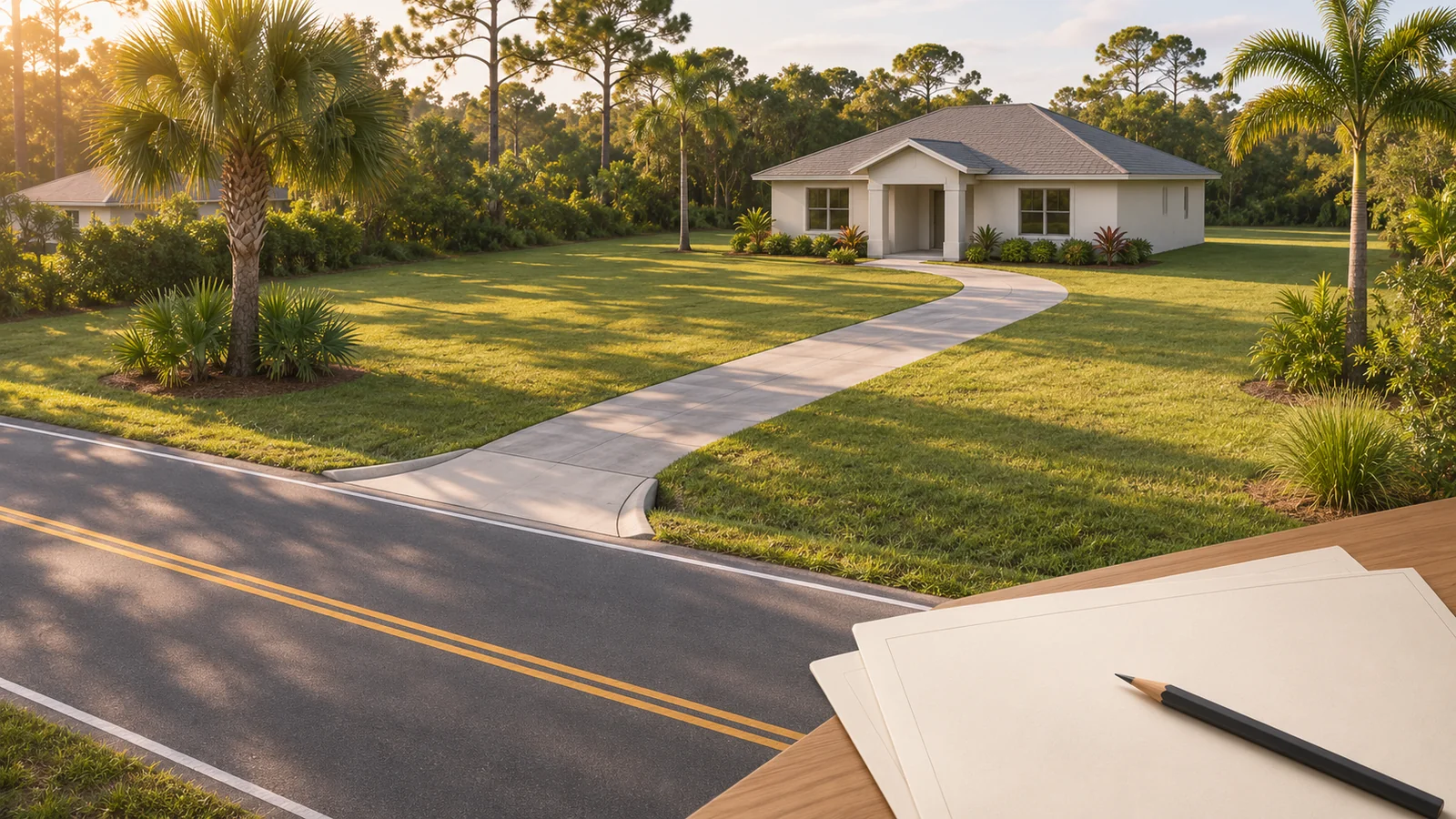
Organize the documents and questions for a lot access inquiry: road authority, right of way, permit scope and coordination with the project design.
Information checked: November 27, 2026. Educational guidance for owners and investors; design and permitting decisions require review by the relevant authority and qualified professionals.
A lot may look ready for a home while leaving an important question unanswered: where will vehicles enter, and who reviews that connection? The preferred location of the house, garage and driveway should start with verified information about the parcel and the road.
Before commissioning detailed plans, prepare an inquiry about driveway access. The goal is to gather documents, identify the responsible office and record unanswered questions. An existing entrance, a cleared strip or a street beside the lot does not establish what work can be approved.
1. Identify the road and the responsible authority
Record the address, parcel identifier and name of every bordering street. Then ask the city or county who administers the road where you propose a connection. If it is a state highway, request the appropriate FDOT contact.
The FDOT access management page brings together permitting resources and county contacts. Coordinating the road with land development is part of that work. The page does not provide approval for an individual parcel.
Keep two questions separate: who reviews the project within the lot, and who reviews its connection to the road? Different offices may be involved. If the parcel fronts more than one street, present both options for discussion without assuming either is acceptable.
2. Separate the lot interior from the right of way
The right of way, or ROW, deserves its own review. Do not establish its limits simply by looking at the edge of the pavement, a fence or the lawn. Gather available documents and ask the authority what information it needs to identify the proposed work area.
Charlotte County provides a useful local example. Its residential driveway page directs applicants to a ROW application when the driveway is located only in the right of way. It also describes a site plan showing property lines and easements. That is guidance for that county, rather than a universal Florida application.
To organize the inquiry, separate proposed work inside the property from work that may reach the road corridor. If documents show an easement or shared access, record the question and refer it to the appropriate professional. This checklist does not determine access rights or replace legal review.
3. Prepare a short, consistent information package
You do not need to improvise a technical solution to begin an informational conversation. You should, however, prevent different participants from working with different locations or document versions.
| Document or information | Question it helps raise |
|---|---|
| Address and parcel identifier | Are we reviewing the correct property? |
| Available survey or site plan | Which boundaries and features need confirmation? |
| Dated photographs of the road | Which existing conditions should be described? |
| Conceptual sketch of the house, garage and entrance | Which proposed connection should be discussed? |
| Available earlier permits or records | Which background documents should the office review? |
| Intended use and proposed work list | Which application fits this scope? |
Label each file with its date and retain the originals. Identify the sketch as conceptual. Ask whether an updated survey, engineering plans or other documentation will be needed before preparing a formal application. This list is an organizational tool, rather than an approved submission package.
4. Confirm the local scope before choosing an application
Hillsborough County distinguishes driveway access applications from other ROW uses. Its page states that this process serves unincorporated Hillsborough County and that the office does not issue these permits for projects inside Tampa, Plant City or Temple Terrace.
The practical lesson is to confirm jurisdiction using the exact address. Being located in a county does not mean every county office processes every project within its geographic boundaries.
When making an inquiry, explain whether you want a new driveway, changes to an existing entrance or information about its records. Ask which review fits the proposed scope and who should prepare the documents. Avoid copying an application, dimensions or materials from a neighboring property: its location and permit history may differ.
5. Discuss access during construction
The driveway you imagine for the completed home does not, by itself, answer construction access questions. Keep a separate list covering equipment arrivals, deliveries, use of the road corridor and possible traffic interruptions.
Ask the authority whether those activities require additional applications. For example, Hillsborough identifies a temporary traffic control permit when a road or lane must be closed. This does not mean every residential project needs that permit; the answer depends on the proposed activity and jurisdiction.
Coordinate these questions with the project team before making execution commitments. Do not schedule work in the road corridor based solely on an initial conversation or the progress of a different permit.
6. Turn the answers into design decisions
Keep a simple record of the question, office contacted, date, response and next action. Distinguish preliminary guidance from issued approval. When information is missing, assign responsibility for obtaining it before treating the entrance location as final.
When FDOT is involved, also ask which documents and edition of the criteria apply. Bulletin RDB 26-02, dated October 30, 2026, announces the 2027 manuals and explains implementation. Owners should not select an edition based only on its year or extend state highway criteria to every local street.
With that information package, the team can review the relationship between the driveway, garage and project layout on a clearer basis. An inquiry does not guarantee approval, cost or timing.
Discuss the lot before finalizing the design
Construction Depot lists feasibility studies, blueprints and project plans, and construction management among its services. You can contact Construction Depot with the property identification, available documents and access questions to discuss the scope of support you need.
Sources and dates
- FDOT — Access Management: official resource with no visible update date; consulted November 27, 2026. Access resources and contacts.
- FDOT — Roadway Design Bulletin 26-02: dated October 30, 2026; consulted November 27, 2026. Original document.
- Charlotte County — Residential Driveway: official guidance with no visible update date; consulted November 27, 2026. Local scope and requirements.
- Hillsborough County — ROW Management Permit: page displays a last-modified date of 9/11/2026; consulted November 27, 2026. Jurisdiction and applications.
The local pages are examples for their respective jurisdictions. This guide does not establish design dimensions, fees or approval timelines.
CONSTRUCTION DEPOT
Let’s build something that matters.
Tell us about your vision. We’ll help you find your next step.